Stereo Miking Techniques
Overview
Abstract
Stereo miking techniques are a frequent discussion point in recording-talk, particularly in the context of drum overheads, acoustic instruments, and ensemble recording. The community debates the trade-offs between XY, ORTF, spaced pair, Blumlein, and mid-side approaches, with a general preference for wider techniques that create an exciting image — even at the cost of some phase complexity.
Community Consensus
- XY is the safest technique — Excellent mono compatibility, less exciting width
- Spaced pair creates more excitement but introduces phase challenges with close mics
- Blumlein with ribbons is beautiful for softer material — Jazz, chamber, acoustic ensembles
- ORTF is a practical middle ground — More width than XY, better phase than spaced pair
- The “right” technique depends on the application and how much you can control the environment
XY (Coincident Pair)
Two cardioid mics at the same point, angled 90-110 degrees apart.
cian riordan (2023-02-01)
“X/Y like that won’t get you much width, the goal is a very natural sounding stereo image that doesn’t fall apart in mono.”
Best for:
- Situations where mono compatibility is critical
- Drum overheads when close mics need to blend cleanly
- BatMeckley: “I tend to xy above the drummers head, or space them like ears”
Limitations:
- Less spatial excitement than wider techniques
- Can sound “big mono” in some contexts
ORTF (Near-Coincident Pair)
Two cardioid mics spaced 17cm apart, angled 110 degrees.
- David Fuller used Soyuz 013 FETs in ORTF for string recording
- More width than XY while maintaining reasonable phase coherence
- A practical choice when you want some spaciousness without the risk of spaced pair
Spaced Pair
Two mics separated by a wider distance (typically 2-6 feet).
- Eric Martin: Uses spaced pair “very tight, more like cymbal mics” for drums, treating them as spot mics rather than a stereo image
- NoahNeedleman: “X/Y is a much safer bet than a spaced pair with regard to having the OHs play nicely with the close mics”
- Wide spaced pairs on ensemble recording with omni outriggers for orchestral/choral work
jantrit (2023-09-03)
“Recording large ensembles is essentially just recording the sound of the room with them in it. A stereo pair with a set of wide omni outriggers will serve you well.”
Blumlein (Crossed Figure-8)
Two figure-8 mics at the same point, angled 90 degrees apart.
- Eric Martin: “I also like blumlein ribbons for softer stuff, either a stereo ribbon or mics that are easy to setup blumlein”
- Iwan Morgan: “Went with a Blumlein pair of R84s in the end to contrast to the Line Audio spaces omnis on the string ensemble”
- Captures room ambience naturally due to the rear pickup of figure-8 pattern
- Sensitive to room quality — works best in good-sounding spaces
Mid-Side (M/S)
A cardioid (mid) and figure-8 (side) at the same point, decoded for adjustable width.
- Less frequently discussed than other techniques in the channel
- Advantage: Width is adjustable after recording
- Useful when you are uncertain about the final stereo image needs
Application-Specific Recommendations
| Application | Recommended Technique | Notes |
|---|---|---|
| Drum overheads | L-C-R (cian), XY, or spaced pair | See Drum Recording Techniques |
| Acoustic guitar | Two SDCs at 15th fret (cian’s method) | One above, one below strings |
| String quartet | Spaced pair + spots | David Fuller: “U87 spaced pair and SF24 blumlein” |
| Large ensemble/choir | Stereo pair + omni outriggers | jantrit: Main pair with section spots |
| Leslie speaker | 90-degree corner technique | Calvin Lauber: “mic it so you’re forming a 90 degree angle” |
| Piano | SDC pair | See Piano and Keys Recording |
Ensemble and Section Recording
String Sections
LAPhill (2023-12-17)
“Your ‘spot’ mics should be probably 18-24 inches away, and you’ll save yourself a lot of harshness if you use the stereo pair that covers the whole section as your main sound. Use the spots just for a touch of detail, if you need it.”
Stacking Sections
jantrit (2025-04-23)
“If planning to stack to make a section I love to set up a stereo room mic and chairs for different positions (cello 1, cello 2, cello 3 etc). Move the player chair to chair between layers but keep the stereo mic in the same spot.”
Gang Vocals / Group Recording
- cian riordan: “Big room, stereo mics… do different takes with the gang standing in different positions, close and far, etc. Power in numbers.”
Tips from the Community
- Use the stereo pair as the foundation of the sound; treat close/spot mics as supplements
- For stacking parts to simulate sections, keep the room mic stationary while moving the player
- The Leslie speaker benefits from a specific 90-degree corner technique
- When in doubt, XY is the safe starting point — you can always try wider techniques on the next pass
- Match your technique to the quality of the room — wider techniques expose the room more
Common Mistakes
- Using spaced pair without checking phase against close mics
- Defaulting to one technique for everything — Each has specific strengths
- Ignoring room quality when using techniques that capture more room (Blumlein, spaced pair)
- Over-relying on width at the expense of mono compatibility
- Placing spot mics too close to string sections, creating harshness
Gallery
3 photos shared in recording-talk. Showing selected highlights.
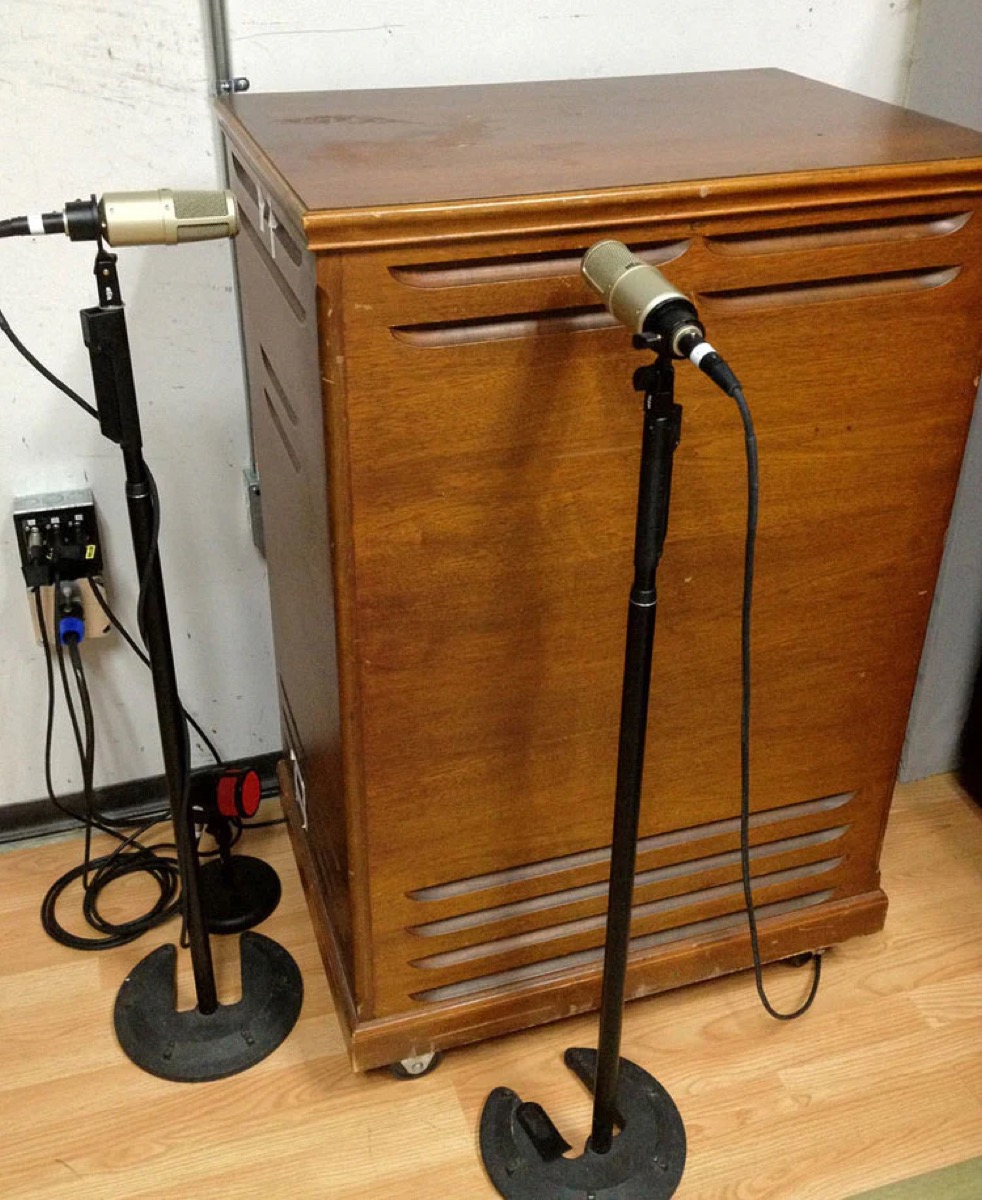 Calvin Lauber (2024-07-30) — They way I learned at ardent/royal in Memphis is to choose a corner of the Leslie and mic it so you’re forming a 90 degree angle, makes for a pretty c
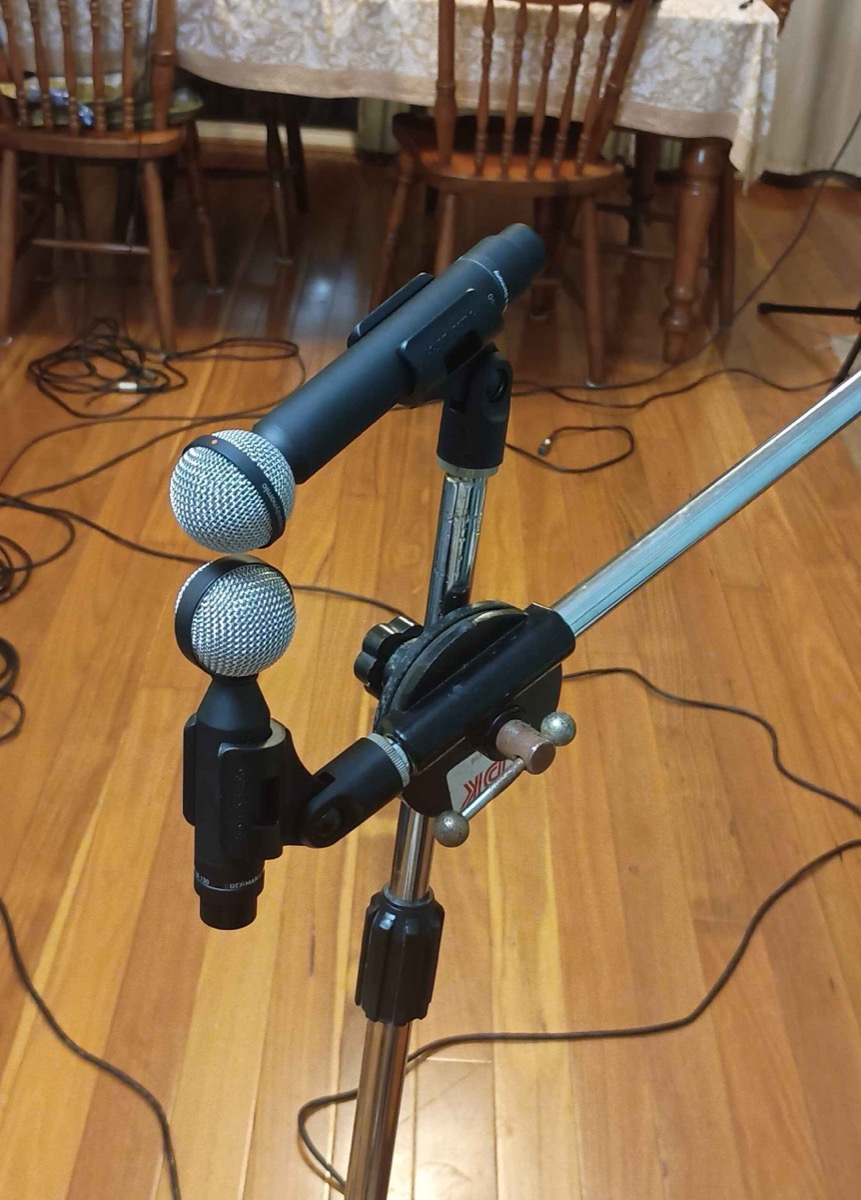 tim adamson 🇦🇺 (2025-02-25) — @Jonathan Arnold while you’re asking about stereo bars, you’re able to put together quite a useful stand by attaching a mic arm with those old school
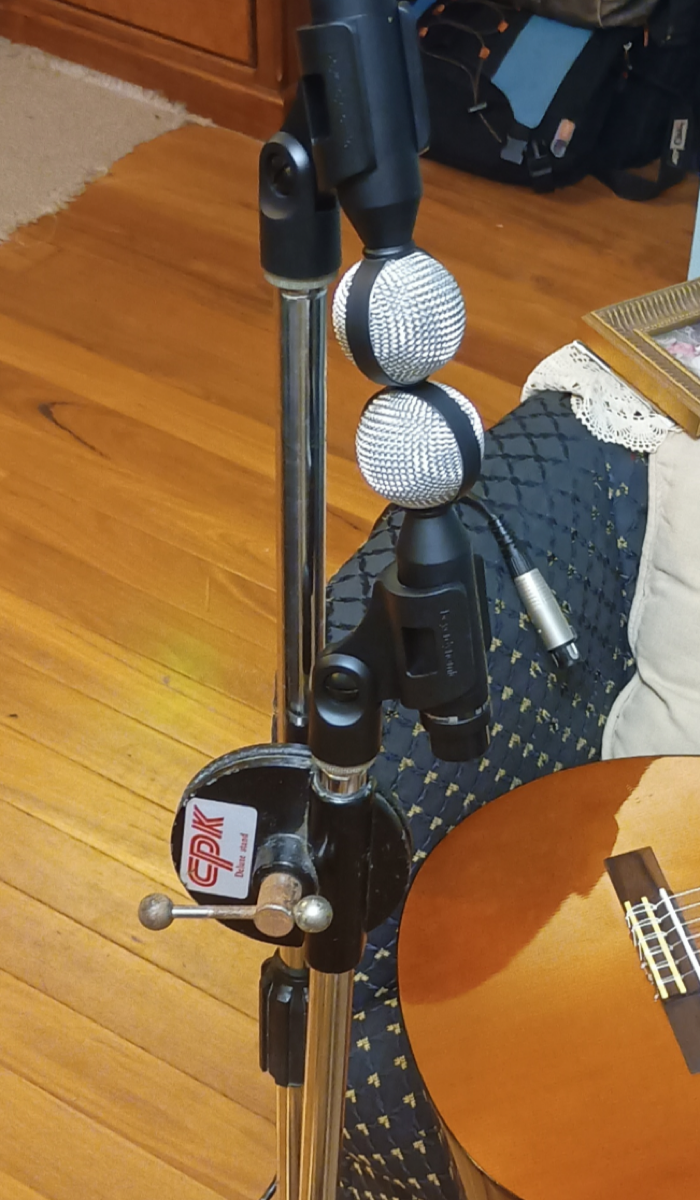 tim adamson 🇦🇺 (2025-02-25) — @Jonathan Arnold while you’re asking about stereo bars, you’re able to put together quite a useful stand by attaching a mic arm with those old school
External Resources
Videos
- https://youtu.be/OZOVZQgXl9k — shared by tomtom (2023-06-23)
- https://www.youtube.com/watch?v=prLQhRYh_Ls&t=67s — shared by LAPhill (2024-08-13)
- https://youtu.be/prLQhRYh_Ls?si=3jNC-Wa-H0k6261N&t=25 — shared by LAPhill (2024-08-13)
- https://youtu.be/prLQhRYh_Ls?si=lg7W4Cb5eXY2r56r&t=25 — shared by LAPhill (2024-08-13)
- Thanxgiving Medley (Higher/My Sacrifice/Don’t Stop Dancing — shared by LAPhill (2024-08-13)
Gear Listings
- https://www.guitarcenter.com/RODE/NT4-Stereo-X-Y-Condenser-Microphone-1274115056248.gc?algoliaQueryID=0539d5a1c31dae49ae9ed13940aa1cfb&algoliaIndexName=guitarcenter — shared by BoozleBAM (2025-12-28)
Other Links
- https://www.allen-heath.com/hardware/me-series/me-500/ — shared by Ross Fortune (2023-12-15)
- https://latchlakemusic.com/accessories/xtra-boom-2/ — shared by Eric Martin (2025-02-25)
See Full External Resources Index for all links.
See Also
Source Discussions
Discord Source
Channel: recording-talk Matches: 151 Key contributors: cian riordan, Eric Martin, BatMeckley, NoahNeedleman, David Fuller, jantrit, LAPhill, Calvin Lauber, Iwan Morgan